Board meeting minutes: example, format and template
How to write board minutes that show each decision was taken properly, with a worked example and a free Word template.
What are board meeting minutes?
Board meeting minutes are the official record of a meeting of a company's directors or a charity's trustees: what the board decided, and how each vote went. Our meeting minutes guide covers what all minutes have in common. Board minutes carry more weight than most because of who reads them later.

Auditors read them to check that large decisions were authorised. A bank or an investor reads them before lending or buying in. In a dispute, they are the main evidence that the directors had the papers in front of them and took advice where they needed it. The next board reads them to find out why something was done the way it was.
So board minutes are written for a reader who wasn't there and may not be friendly.
What should board meeting minutes include?
Everything formal minutes carry, from the quorum to the actions, which the minutes guide lists in full. A board adds a few things of its own:
- The kind of meeting. A regular meeting, or a special one called between regular meetings for particular business, and how notice was given if the rules set a period.
- Everyone in the room, by role. Directors present and absent, and others in attendance who take part but don't vote, such as an adviser, or a chief executive who isn't on the board.
- Conflicts of interest, and what followed. Whether the director left the room, or stayed and didn't vote, recorded against the item.
- The papers the board considered. "The board considered the draft budget (paper 2)" is the line that shows a decision was informed.
- Dissent, when a director asks. In many US states, corporation law treats a director who was at the meeting as having agreed to a decision unless their dissent or abstention is entered in the minutes, or they register it in writing as the law allows. A director who disagrees should ask for it to be minuted, and the secretary should write it down.
- Closed sessions. When the board meets without staff, for example on the chief executive's pay, the main minutes say so, and the detail goes in a separate minute with restricted circulation.
How much detail should board minutes record?
Enough to show the board did its job, and no more.
Minutes that only list resolutions, such as "Resolved: to approve the budget", prove the decision but not that the board thought about it. If the decision is questioned later, nothing shows the board had the figures or asked about the risk. Minutes that record the whole debate cause the opposite problem. Every half-formed remark becomes part of the record, and a passing doubt reads years later as a warning the board ignored.
The usual middle course, for each item that ends in a decision:
- the paper the board had, by name or number
- a sentence or two on the points that shaped the decision, without saying who made each one
- the resolution, with the vote
2a. 2027 budget
JC said the pay award was too high with donations down, and HB disagreed strongly, saying staff had waited two years for a rise. After some back and forth PA called a vote.
Resolved: to approve the budget.
the 2027 budget of £1.21m, including a 3% pay award from AprilProposed HB · seconded DK · 7 for, 1 against. JC asked for her vote against to be recorded.numbers, not “approved”Legal advice stays out whatever the format: many boards minute that advice was given, and by whom, rather than what it said, so the minutes can be shared without the advice in them. Side conversations stay out too.
How do you record a board resolution?
A resolution is a decision the board has formally made. Its minute should make sense copied out on its own, because it often is, onto a bank's form or into a contract.
Start with the verb. "Resolved: to approve…", or in the American style, "RESOLVED, that the Company…". Use "agreed" for a decision reached without a formal vote, and keep "noted" for something the board received without deciding anything.
Name the thing exactly. "To approve the lease of Unit 4, Mill Lane, for five years from 1 January 2027 at £18,000 a year", not "to approve the lease".
Record how it passed. Who proposed it, who seconded it if your board records seconders (boards that follow Robert's Rules name only the mover), and the vote as numbers. A vote with nobody against and nobody abstaining can read "carried unanimously". If anyone abstained, give the numbers, and name them if they ask.
Group routine items, and minute what was put off. If the board takes routine items together as a consent agenda, minute them as one resolution that lists each item, and give any item a director takes out its own number. An item put off is minuted as deferred to a named meeting.
Say who may act on it. Many resolutions need someone to sign or carry them out: "and to authorise the chief executive to sign the lease on the board's behalf". A bank or a landlord will look for that line.
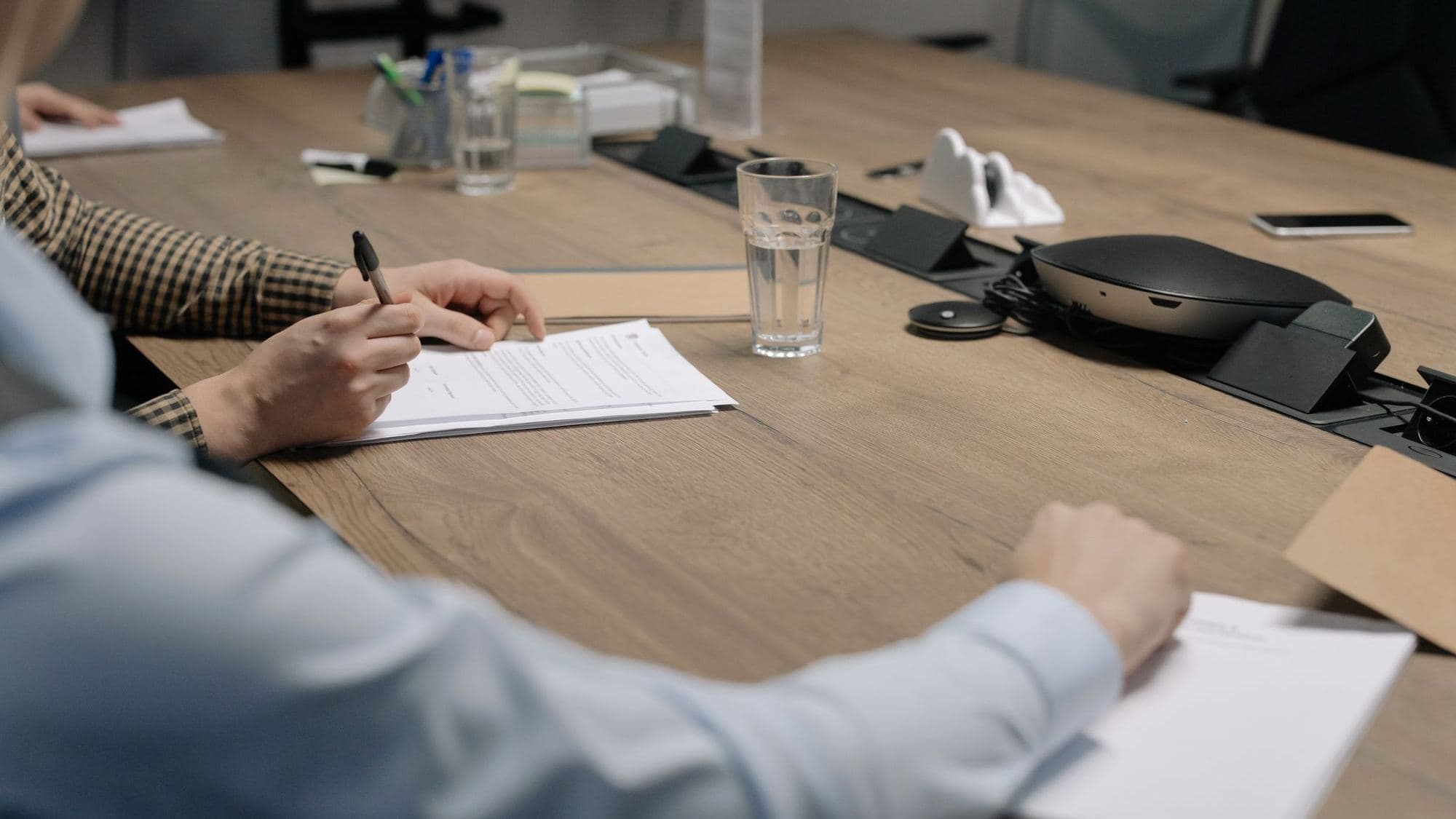
Decisions taken without a meeting go in the record too. Under the UK model articles, a private company's directors can take a unanimous decision in writing, and many US boards act by unanimous written consent. Either way, the signed document goes into the minute book alongside the minutes.
Board meeting minutes example
The board meeting that received the recommendations in our committee minutes example, filled into the template below. JC's vote against is recorded by name because she asked, and one item was taken in closed session.
Thursday 26 November 2026, 18:30
Regular meeting, notice and papers sent 19 November · Board room, head office, with video · Chair: PA · Minutes by: SM, company secretary
Present: PA, DK, HB, JC, MW, NR, RS, TO · Apologies: AF · In attendance: CE (chief executive), TL (finance officer) · Quorum: met (five trustees needed)
MW declared an interest in item 3, as her employer quoted in the audit tender, and left the meeting for that item
- The minutes of 24 September were approved as an accurate record
- Reserves policy: referred to the finance committee on 24 September; returns as item 2
- 1. Chief executive's report (paper 1): noted, including donations £26,000 below forecast to 31 Octobernumber
- 2. Finance committee: the draft minutes of 12 November (paper 2c) were received, with its recommendations
- 2a. The board considered the draft budget (paper 2a) and the finance committee's recommendation, weighing the pay award against donations £26,000 below forecast. Resolved: to approve the 2027 budget of £1.21m, including a 3% pay award from April. Proposed: HB · Seconded: DK · Vote: 7 for, 1 against. JC asked for her vote against to be recorded.decision
- 2b. Agreed: to adopt the reserves policy, holding three to six months' running costsdecision
- 3. Resolved: to recommend to the members at the AGM that Fenwick Marsh, ranked first in the tender (paper 3), be appointed as auditors for the year ending 31 December 2027. Proposed: RS · Seconded: NR · Vote: 7 for, 0 against, MW absent.decision
- 4. Safeguarding policy, annual review (paper 4): agreed with no changesdecision
- 5. Chief executive's pay: taken in closed session after CE and TL left; pay for 2027 agreed, with the detail minuted separately
None
- TL — issue the approved 2027 budget to managers — by 4 Decemberowner + date
- CE — bring a revised fundraising forecast to the January meeting — by 21 Januaryowner + date
- SM — put the auditor resolution in the AGM notice — by 14 May 2027owner + date
Meeting closed at 20:05. Next meeting: Thursday 28 January 2027, 18:30, head office
To be signed by PA once approved at the next meeting
Every resolution can be read on its own, with its proposer and its vote. The auditor item is a recommendation, because the members make that appointment at the AGM, and MW's absence from the vote is on the record. The closed session appears as one line, with nothing in it that the staff who left shouldn't read.
Board meeting minutes template
For the boards of companies and charities. Declarations of interest come before any business, and every resolution has a line for how it was proposed and voted on. Download the blank Word form, free and with no sign-up, or copy the worded version below into your own document.
[date], [start time]
[Regular / special] meeting · Notice: [date sent, or waived] · [venue or video link] · Chair: [name] · Minutes by: [name]
Present: [names] · Apologies: [names] · In attendance: [non-members, e.g. auditors] · Quorum: [confirmed / not met]
[name] declared an interest in item [n], or "None declared"
The minutes of [date] were approved as an accurate record.
[item]: [update against a previous action]
[n]. [Agenda item]. The board considered [subject].
Resolved: [what was decided]. Proposed: [name] · Seconded: [name] · Vote: [for / against / abstentions]
[item], or "None"
[owner] — [task] — by [date]
Meeting closed at [time]. Next meeting: [date, time, place]
[chair's signature] · [secretary's signature, if your rules ask for it] · [date approved]
Bring it to Sorinai and it fills in each field as the meeting reaches it, then writes the answers into your own Word file when the meeting ends. Every answer keeps the transcript quote it came from, so a vote count or a figure can be checked before the draft goes round. See how template filling works. For the board's agenda, which this template follows item by item, see our guide to the board meeting agenda.
How do you take and approve board minutes?
In the meeting. Set the minutes up beforehand from the agenda and the board pack, with the item and paper numbers already typed, so in the room you only write outcomes and votes. Note the time anyone arrives or leaves, against the item, and check the quorum still holds before the next vote, because a decision taken without one may not stand. If a resolution's wording isn't clear, ask the chair to read it out before the vote. The general steps are in our minutes guide.
After it. The chair checks the draft within a few days. It then goes to the board marked as a draft, and again with the papers for the next meeting. There the board approves it, with any correction written into the approval ("approved as an accurate record, subject to correcting the figure in item 2a"), and the chair signs, on paper or in the board portal. A mistake found after that is put right by a minute at a later meeting, not by editing the signed copy.
Board meeting minutes FAQ
Who takes the minutes at a board meeting?
Usually the company or corporate secretary, or in a charity the board secretary or clerk. Where there isn't one, a member of staff who attends without a vote often takes them, so no director has to follow the debate and write it down at the same time. On a small board with no staff, one of the directors or trustees does it.
Who signs board meeting minutes?
In the UK, the chair signs them once the board has approved them at its next meeting. In the US, the secretary usually signs them, as Robert's Rules and most bylaws provide, and some boards have the chair sign as well. The signed copy goes into the minute book or the board portal as the official record.
How long should board minutes be kept?
In the UK, a company must keep minutes of its directors' meetings for at least ten years from the date of the meeting. US state corporation laws require board minutes to be kept with the corporation's records. In practice most organisations keep them for good, since they are the only record of why things were decided the way they were.
Are board meeting minutes public?
Not usually, for a company or a charity. They are internal records: the directors and the auditors see them, and the public doesn't. In the UK, members have a right to inspect the minutes of general meetings but not of directors' meetings. In the US, a shareholder with a proper purpose can demand them under state law, such as Delaware's books-and-records rule. Public bodies, such as councils and school boards, are the exception: open-meeting laws usually require their minutes to be made available to the public. In a legal dispute, though, any board's minutes are business records the other side can ask for, and a court can order them to be produced. Legal advice recorded in them may be protected, which is another reason boards minute that advice was given rather than what it said.
What is the difference between board minutes and a written resolution?
Minutes record a meeting. A written resolution records a decision taken without one, signed by the directors instead. It goes into the same minute book so the record stays complete, and the next board meeting usually notes it.
